In addition to Super Galactic Baseball Defense, I also provide insights into some of my smaller and older projects that I believe are remarkable in some way. I’ve left out many other projects that I feel don’t quite belong here.
X-Treme robot chat

Introduction
Before anything else you can play X-Treme robot chat here.
X-Treme Robot Chat is a small project from my college days. The entire game was built around one simple concept: all actions are bound to a single button.
Project Details
- A practice exercise for college
- Developed in 2 weeks (part-time)
- Unity
- Arcade
- Third person
Click here to display more details
Story
The story is simple: a robot tries to communicate with his partner, but due to a malfunction, he has to reboot his speech system. While he struggles with this, his partner gets angrier by the second. If the anger maxes out — game over. The real (and very dumb) excuse is that the protagonist just wants to find out if Half-Life 3 came out.
Gameplay
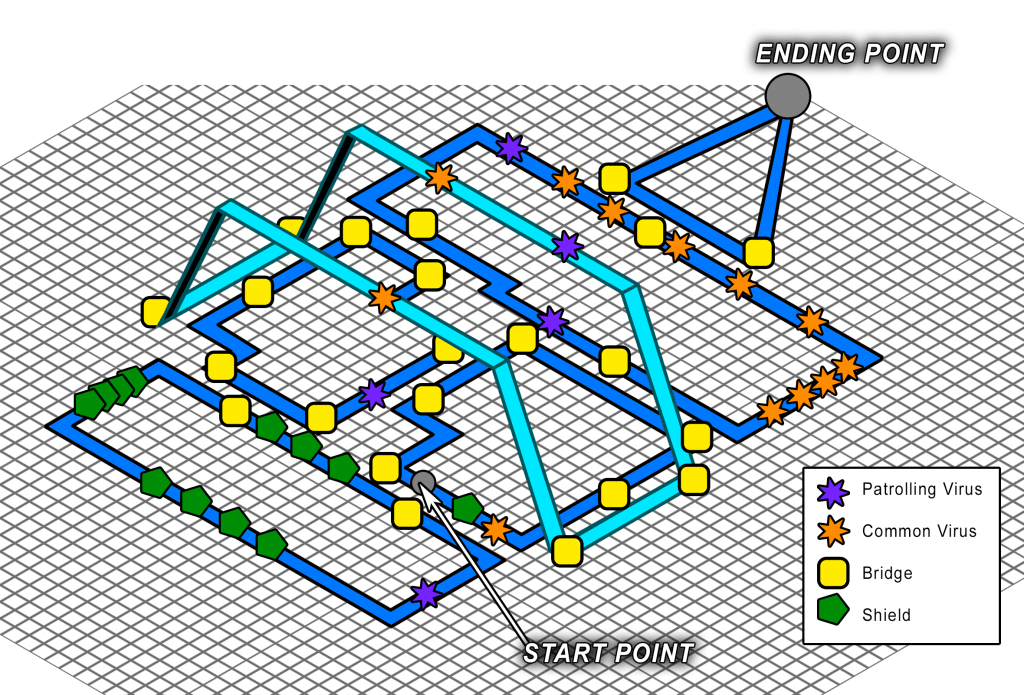
The player’s movement is on rails; the only actions they can perform are jumping and switching lanes. The goal of the game is to destroy all the orange viruses, which can be eliminated using energy shields collected throughout the level. Once that’s done, the player must reach the end of the level and reboot the speech system to finish the game.
Level design
The player starts on a safe rail (with no enemies), and as soon as they begin moving automatically, the core game mechanics are introduced. The player picks up a shield, and in the next moment, they destroy an orange virus — which is the main objective of the game. In contrast, purple viruses cannot be destroyed and must be avoided, as they pose a threat.
There are six lanes, each with a specific function:
- The starting lane is a safe zone.
- The aerial lane adds verticality and encourages exploration.
- The energy shield lane is where players collect the shields needed to destroy orange viruses.
- The lane adjacent to the starting lane contains large amounts of health.
- The virus lane holds most of the orange viruses.
- The final lane leads to the end of the level.
Final thoughts
This is one of my oldest projects, and I know that if I had to remake it today, I would approach it very differently. I’d also add more functionality to the single-button mechanic — for example, by taking advantage of actions like holding the button down.
Project November

Introduction
Before anything else you can play Project November chat here.
This is a small project focused on sharpening my programming skills. The security cameras, which use interconnected AI systems to perform simple tasks, are programmed using finite state machines.
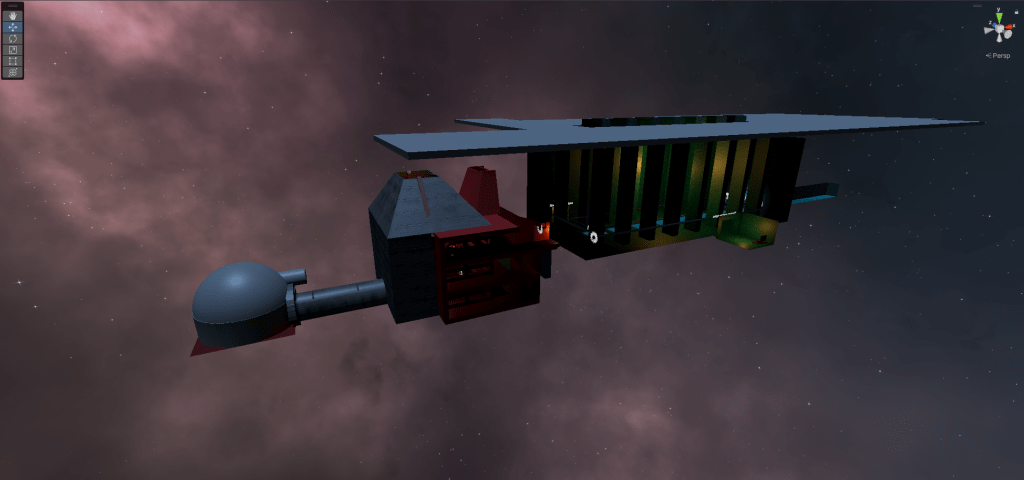
The game itself was meant to lay the groundwork for an immersive sim — which never fully materialized — but I’m satisfied with the result. It features simple puzzles, a dialogue system, and multiple approaches to problem-solving.
Project details
- Personal project
- Developed in one months (full-time)
- Unity 2021
- Immersive Sim Prototype
- First person
Click here to display more details
Design
The core pillars of this project are:
- The AI system for the security cameras, which behave intelligently and react to the player’s actions.
- Environmental interaction, where weapons are used more as tools than simple combat devices.
- The use of terminals, which can be accessed to gather information or hacked to open doors and disable electronic devices.
Security cameras
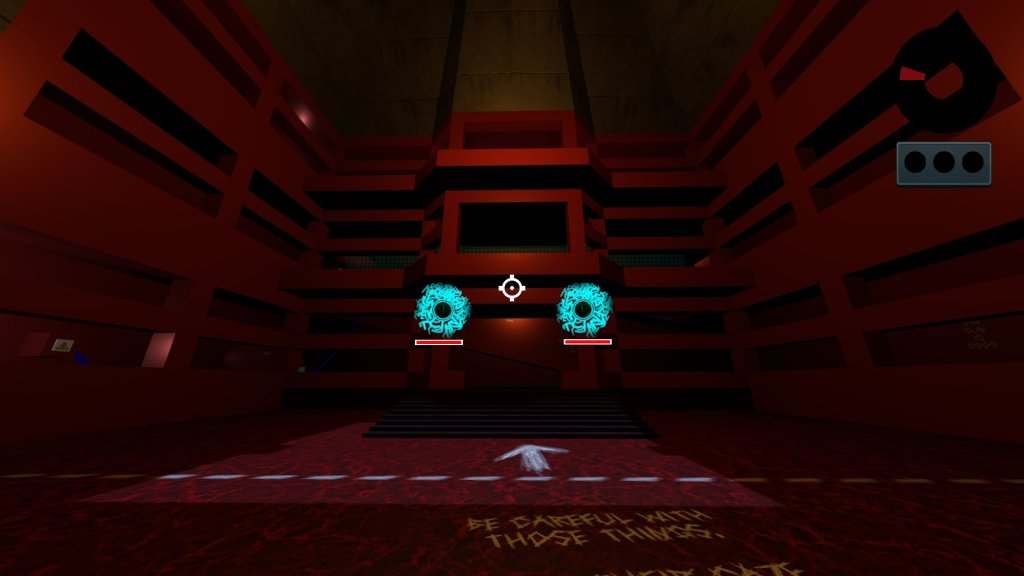
There are two types of cameras: fixed and mobile. Mobile cameras move along rails but otherwise behave similarly to the fixed ones, with the key difference being that they will always be patrolling along a railway.

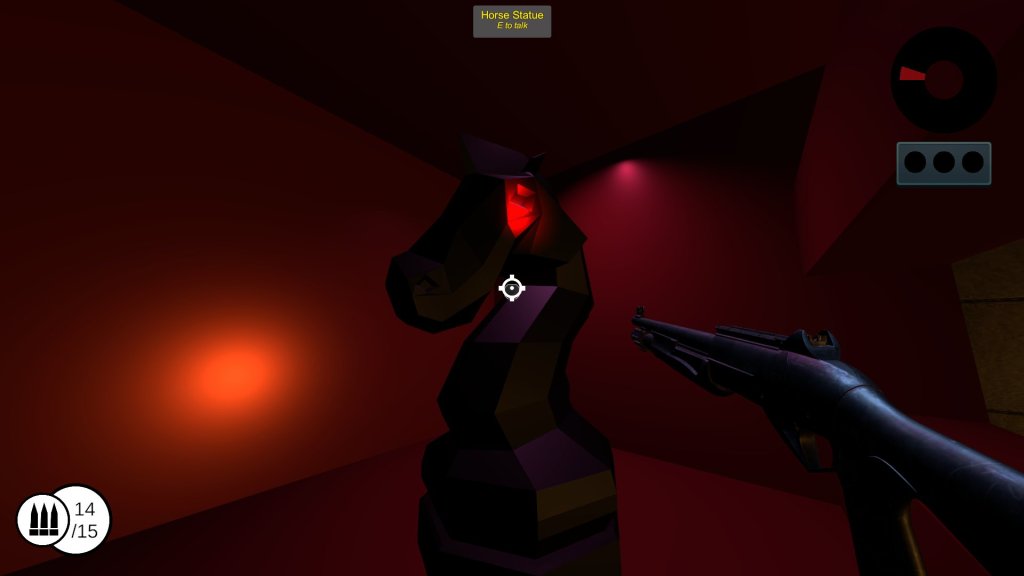
If a camera detects you, an alarm is triggered and the doors in the current room will lock, trapping you inside. Cameras with a visible halo are also capable of attacking: if you’re within their range, they will engage. If you’re outside their attack range, they enter a heightened surveillance mode.
Camera halos indicate their current state:
- Blue = looking for anomalies
- Orange = combat mode
- Red = attacking
- White = deactivated
Cameras can be destroyed, but attacking them will trigger the alarm. The most effective method is to find a terminal and shut them down remotely. Alternatively, an EMP device can disable them temporarily. If their power source is exposed, you can destroy it to completely shut them down, leaving them in a catatonic state.
Hacking

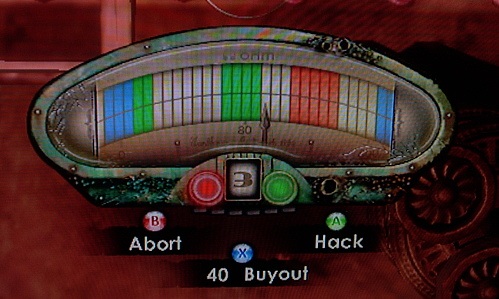
The hacking system is very simple. Once you acquire the hacking device, you need to press the action key when the cursor is over the green arrows. If you press it on a red arrow instead, you lose health. This system is inspired by BioShock 2.
Story
The story is very simple: the player’s character wakes up in a hostile environment. Later, it’s revealed that you’re in an abandoned underground facility where the systems are still functioning. Your only ally is a set of nodes connected to the main network, whose sole purpose is to help people.
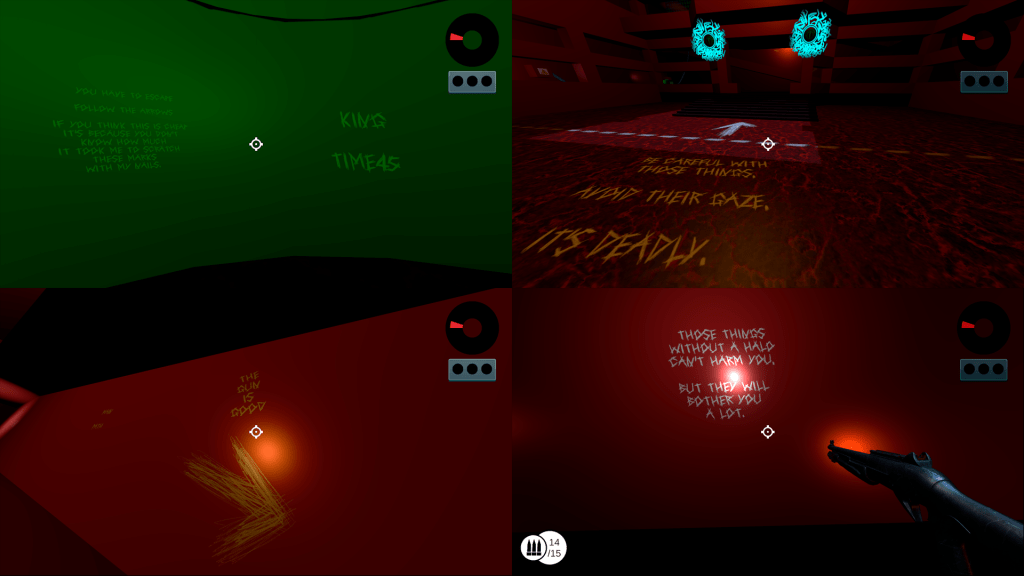
Much of the information is delivered to the player through markings on the walls — similar to the Ratman messages in the Portal series. I regret this choice a bit, as it ended up being too explicit and needed more subtlety to truly convey the atmosphere I was aiming for. Furthermore, I know for sure that I overused the technique.
Final thoughts
I think that when I started developing this game, it was beyond my skill level at the time — but despite everything, I learned some valuable lessons about programming and storytelling.
One of the things I believe I achieved with this project was creating a disturbing atmosphere using ominous music, red lighting, and a claustrophobic, ascending level design that occasionally shows the sky — but always just out of reach.
By “atmosphere,” I refer to the combination of environmental elements in the game world that work together to evoke a specific emotional response — in this case, a sense of unease, deliberately crafted by the designer.
El Encargo

Introduction
Before anything else you can play El Encargo chat here (it’s only in Spanish).
El Encargo (or The Commission) is a narrative-driven horror game centered around an infinite time loop and a Lovecraftian mystery. You choose what to do next in an attempt to break the loop, but almost every possible decision leads to death. It was a practice exercise for a master’s degree. We were assigned to create a small choice-driven game with a free theme.
Project Details
- A practice exercise for a master’s degree
- Developed in one week (part-time)
- Unity 2023
- Narrative-driven horror
- First person
Click here to display more details
Choice design
There are a few paths to explore in the game. I wanted to include even more, but within that tight timeframe, it was impossible.

Level design
All the levels serve as environments to create atmosphere. In every one of them—except for the cabin and the final level—it’s raining. This is a way to show the player that they’re inside the storm. When they reach the end, the player finds themselves in the eye of the hurricane: everything seems calm on the surface, but the worst is yet to come.
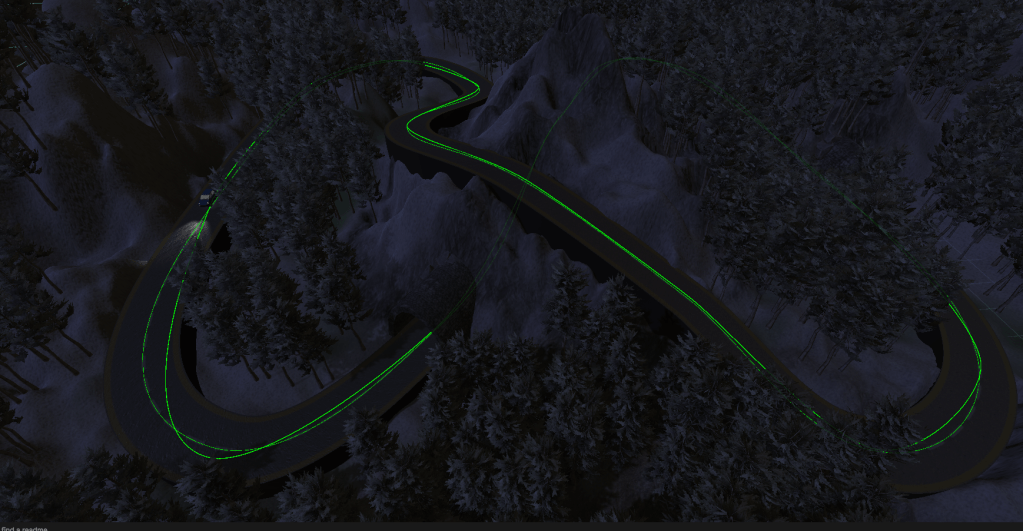
The car level features a looping road and serves as a metaphor for the player’s state. It also functions as a level-saving technique, similar to the train scene in Uncharted 2.
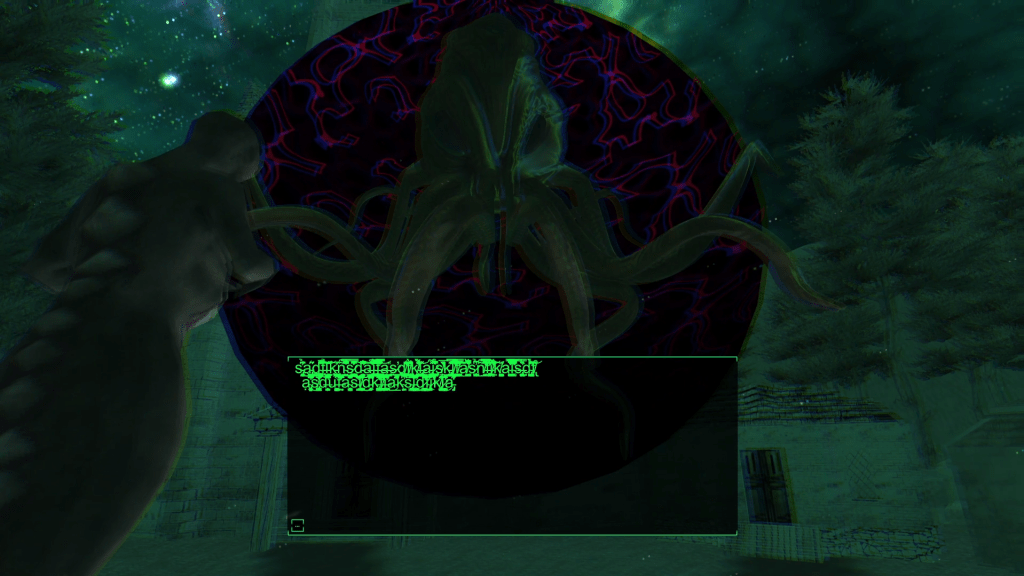
In the final level, the player can no longer move freely; player are dragged against their will by a mysterious force and forced to face their fate, whether they want to or not. For this reason, the atmosphere I aimed to create is akin to an unholy sacrifice to a god. When the ancient god appears, the screen distorts as if the game itself is malfunctioning. The player sees the beast from a low-angle shot that emphasizes their feeling of inferiority.
Final thoughts
For a short window of time, I’m very happy with what came out. I was able to mix some assets to create a solid experience. Even though I’m pleased with the result, the esoteric part of Lovecraftian horror needs more work, and some dialogues could use improvement.
Untitled game for AI behavior practice

Introduction
I made this game just to practice enemy AI behavior. It’s very simple and small. The enemies’ goal is to eat all the fruits in the garden, and you must stop them. When the enemies harvest a fruit, they’ll look for a new one. If they eat them all, you lose. If any enemy sees the player, they will attack until either the player dies or the enemy is defeated.
Almost all of the assets used can be found on the Unity Asset Store. I coded the enemy behavior myself using finite state machines, and I also programmed the player controller and aim animations.
Project Details
- Personal project
- Developed in two weeks (full-time)
- Unity 2021
- Third person shooter
Vendimia 1936
Vendimia 1936 (or Grape Harvest 1936) was my master’s thesis project. It’s a game set during the Spanish Civil War from the perspective of a Castilian farmer who personally experiences the abuses committed by the fascist faction. It’s a project in the very early stages.
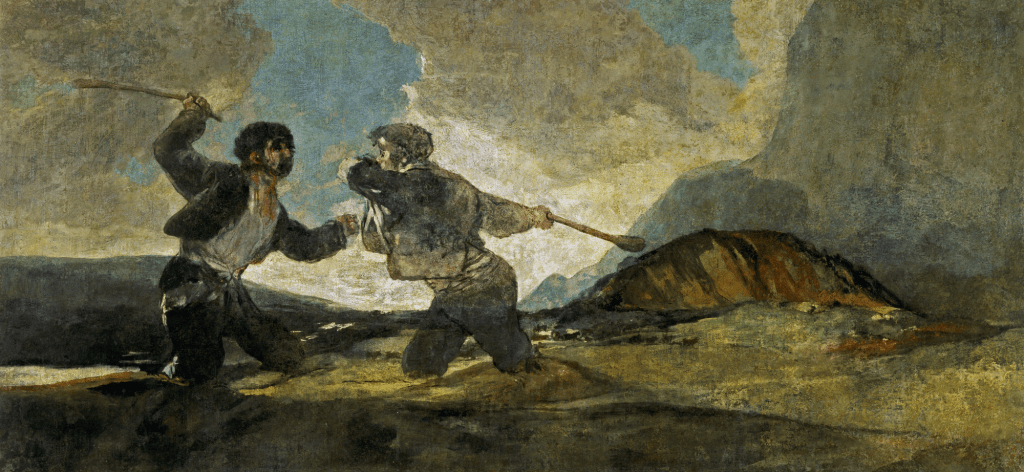
This game explores the lost culture of early 20th-century Castilla, affected by the war and the subsequent depopulation of inland Spain. It takes an anthropological approach, focusing on nearly forgotten or declining traditions such as la cencerrada, correr los gallos, and native games like la tuta. The game also delves into Castilian myths, including la estantigua, the Castilian version of the Wild Hunt with some unique local traits.
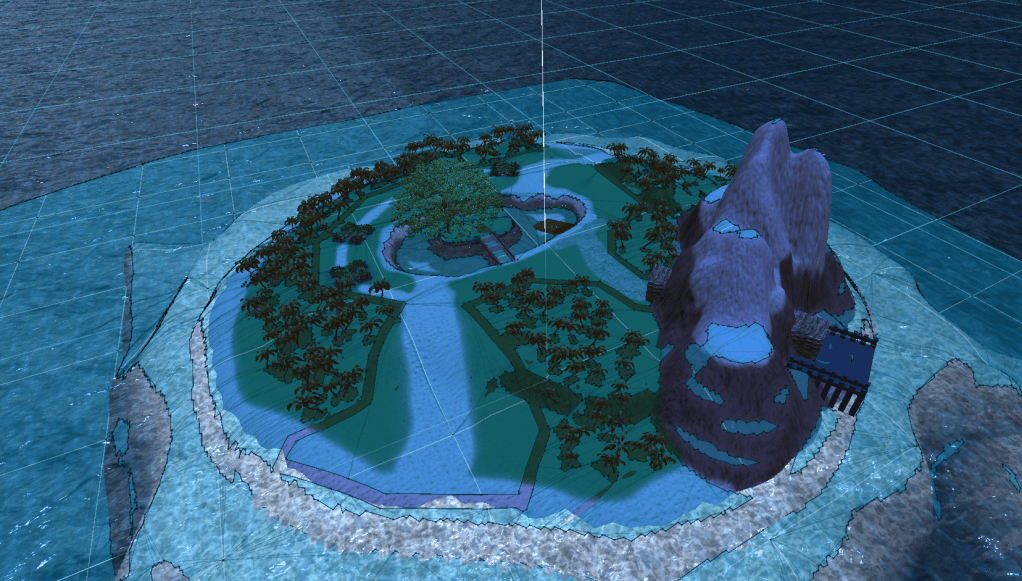
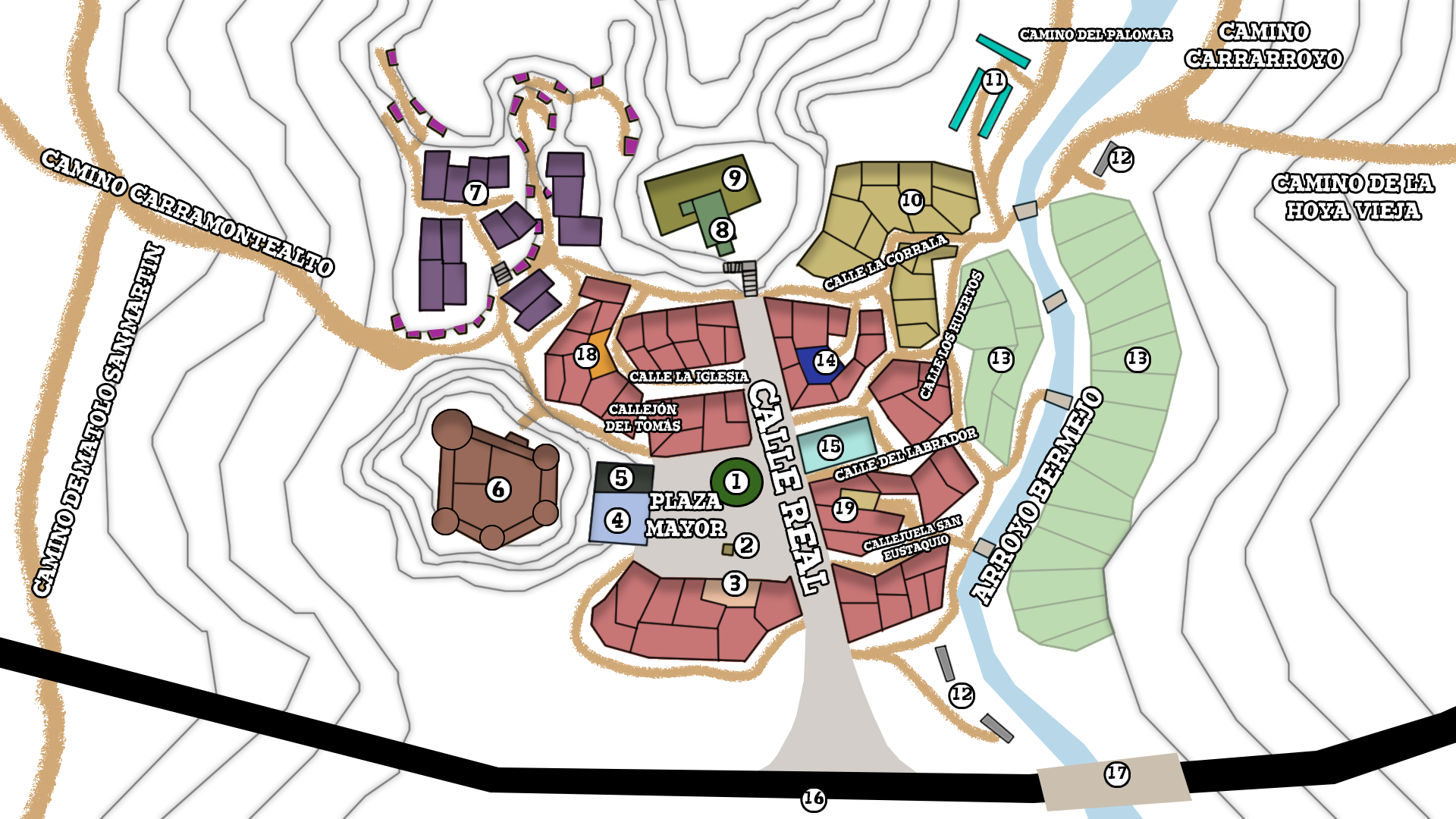
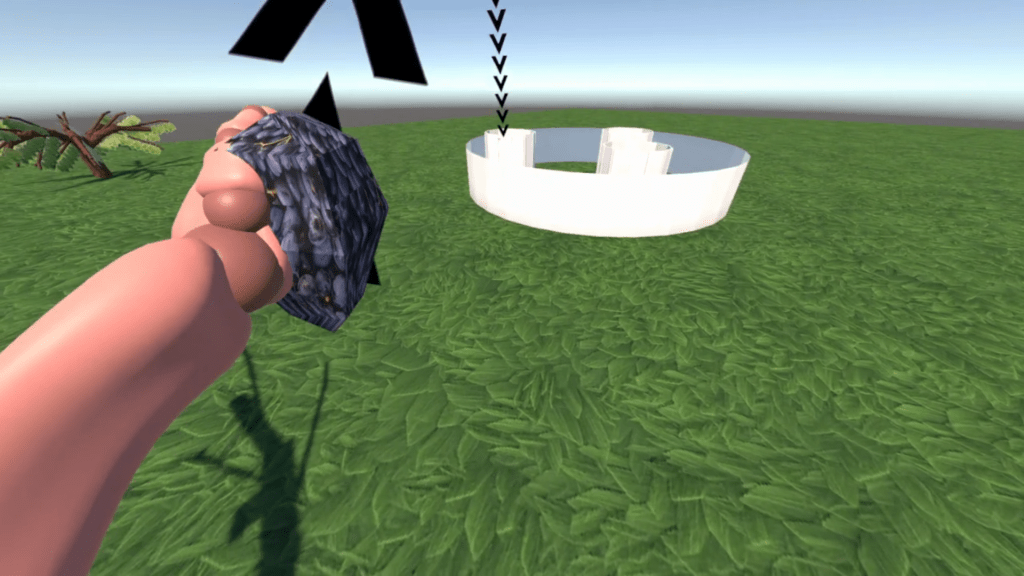
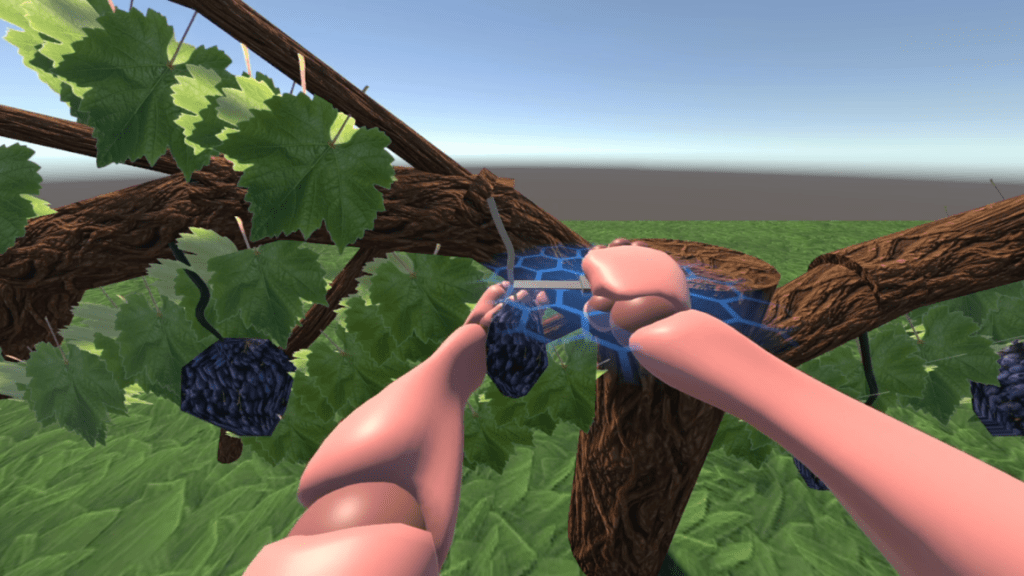
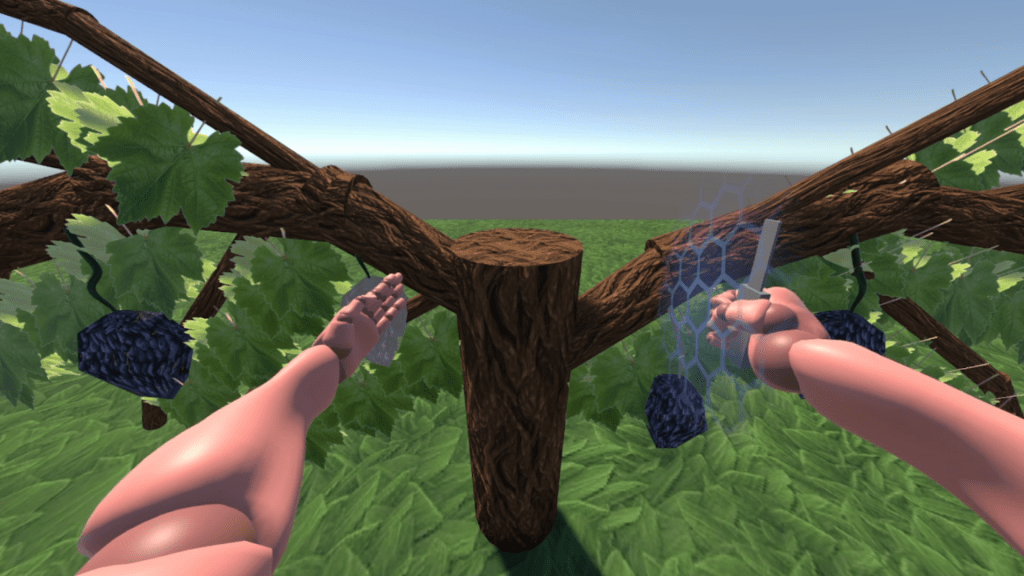
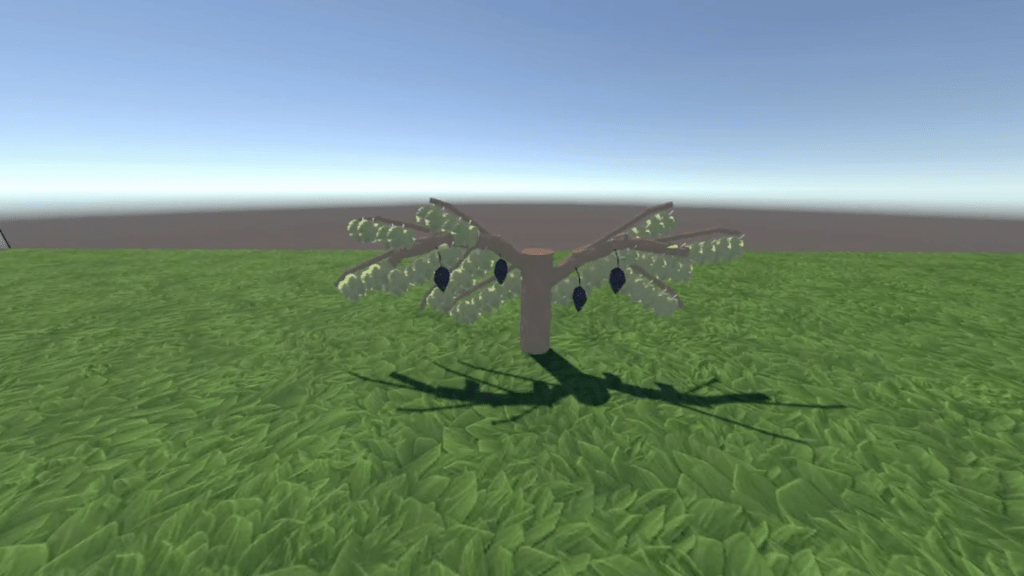
It’s a project that’s currently on hold, but I hope to continue it someday. Here you can see some screenshots of the first prototype I made in two weeks.
The story is simple. Drawing inspiration from the great classic of Hispanic literature, Chronicle of a Death Foretold, I conceived a narrative about the last week of a peasant who is about to be accused of treason and sentenced to be executed by firing squad. However, through a series of flashbacks, the player can change the character’s fate.
Finally you can see the design document I created for the project. It’s only in Spanish.
Check out my biggest project.
 Rodrigo García Benedicte Portfolio